Why Most Debt Tools are Useless
Debt Reality Series — Post 5 of 5
Start with Post 1: Why Most Debt Advice Doesn’t Work (And What Actually Does) if you haven’t read it yet.
We've spent four posts dismantling generic debt advice and rebuilding strategies that fit reality. We've exposed the marketing formulas, tackled when balance transfers actually work, destroyed the subscription cut fantasy, and shown you how to choose a debt payoff method based on your actual constraints.
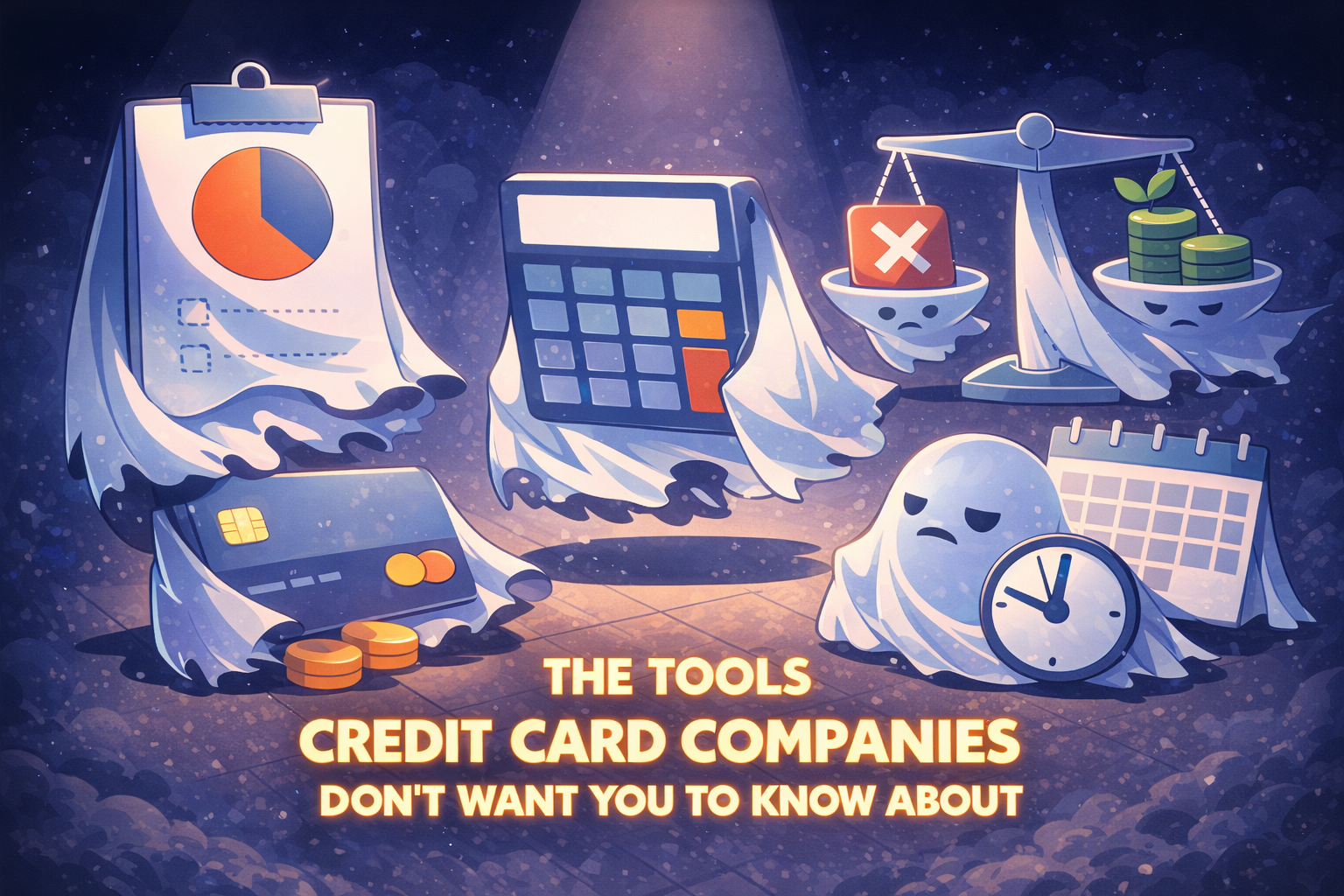
Now let's talk about the tools that are supposed to help you execute all this—and why most of them are useless.
I've spent months analyzing debt payoff apps and calculators. The vast majority are glorified spreadsheets wrapped in motivational quotes and progress bars. They're built by people who understand software but have never actually been stuck in high-interest debt, wondering which bill to pay first.
Here's what frustrates me: There's a massive gap between what debt tools do and what people actually need.
Most apps assume you have stable income, good credit, simple debt structure, and just need help staying motivated. But if that's your situation, you barely need an app—you need a spreadsheet and some discipline.
The people who actually need sophisticated tools are dealing with irregular income, damaged credit, psychological complexity around money, and structural barriers that standard calculators completely ignore.
We built OutDebt because we were tired of saying this and not doing anything about it. It's not another progress bar wrapped in motivational quotes. Free tier: real debt mapping, real payoff calculations, avalanche vs. snowball comparison for your actual balances. No lead magnet. No consultation pitch. Just the tool. Try OutDebt free
So I'm building something different. Not another debt calculator that tells you "if you pay $X per month, you'll be debt-free in Y months." That math is trivial. What's hard is the reality of life getting in the way.
Let me show you what's broken in existing debt tools and what actually needs to exist.
What Current Debt Apps Get Wrong
Problem #1: They Assume Stable Income
Every debt payoff calculator has the same input field: "How much extra can you pay each month?"
What if the answer is: "$800 some months, $200 other months, and negative $100 when the car breaks down"?
Standard apps can't handle this. They optimize for consistency that doesn't exist for gig workers, freelancers, commission-based salespeople, or anyone with seasonal income.
Problem #2: They Ignore Psychological Complexity
Most apps treat debt payoff as pure math. Pay this amount. Hit this milestone. Watch progress bar fill up.
But debt isn't just math. It's:
-
Shame about past financial decisions
-
Anxiety about future emergencies
-
Relationship conflict over spending
-
Identity ("I'm bad with money")
-
Behavioral patterns that created the debt
You can't gamify your way out of psychological barriers with a progress bar and a trophy icon.
Problem #3: They Optimize for the Wrong Success Metric
Apps celebrate: "You've paid off $5,000 in debt!"
What they should track: "You've made 6 consecutive months of payments without missing one or creating new debt."
The first metric measures output. The second measures sustainable behavior change. Guess which one actually predicts long-term success?
Problem #4: They Don't Account for Setbacks
Life happens. Car breaks down. Medical emergency. Hours get cut at work. Kid needs expensive thing for school.
Standard debt calculators treat setbacks as failure. The timeline extends. The progress bar shrinks. The app basically says: "You're behind plan. Try harder."
This is psychologically devastating and completely ignores that setbacks are inevitable over an 18-36 month debt payoff journey.
Problem #5: They're Built for the Johnsons
Remember the Johnson family from Part 1? Combined income $78K, manageable debt loads, good credit, stable employment?
Every debt app is optimized for them. Clean inputs. Predictable outputs. Linear progress.
What about:
-
Single parent with $32K income and irregular hours?
Freelancer with variable monthly income?
Someone with 580 credit score who can't access balance transfers?
Person dealing with collections and judgments?
These situations don't fit the clean calculator model. So these people get generic advice that doesn't work and tools that don't fit.
What Actually Needs to Exist
If I'm building a debt tool that addresses reality instead of spreadsheet fantasies, here's what it needs to do:
Feature #1: Variable Income Modeling
What it does:
-
Accepts income ranges, not fixed monthly amount
-
Models "payment floor fund" strategy (from Part 4)
-
Shows different scenarios: "If you have 3 high-income months this quarter, you'll pay off Card B by November"
-
Adjusts recommendations based on actual income this month
Why it matters: 35% of U.S. workers have variable income. None of the major debt apps handle this well.
Feature #2: Root Cause Analysis
What it does:
-
Asks why you accumulated debt (medical, job loss, lifestyle inflation, systemic wage issues)
-
Tailors strategy based on cause
-
Identifies whether you need behavioral intervention, income growth focus, or structural support
Why it matters: Debt payoff without addressing root cause has 60%+ relapse rate within 2 years.
Feature #3: Psychological Checkpoints
What it does:
-
Tracks emotional state, not just dollars
-
Asks: "How sustainable does this feel right now?" (1-10 scale)
-
If sustainability drops below 6, suggests modifications before you quit entirely
-
Celebrates process wins (consecutive payment months) as much as outcome wins (balances paid off)
Why it matters: Most people quit debt payoff plans due to psychological burnout, not mathematical impossibility.
Feature #4: Setback Recovery Protocols
What it does:
-
When you report an emergency expense or missed payment, it doesn't just recalculate timeline
-
Provides specific recovery scripts and next steps
-
Distinguishes between "temporary setback" and "strategy needs adjustment"
-
Normalizes setbacks as part of the process, not failure
Why it matters: How you handle month 8's $1,200 car repair determines whether you're debt-free in month 30 or back at square one in month 36.
Feature #5: Multiple Strategy Comparison
What it does:
-
Shows you avalanche, snowball, and hybrid approaches side-by-side
-
Displays real cost difference (not just "avalanche is better")
-
Asks which feels more achievable to you
-
Lets you switch strategies mid-stream without judgment
Why it matters: The "mathematically optimal" choice that you abandon in month 5 is worse than the "suboptimal" choice you complete.
Feature #6: Credit Score Integration
What it does:
-
Shows which strategies you actually qualify for based on current credit
-
Explains why you can't access certain options (not just "you don't qualify")
-
Provides roadmap: "If you improve score to 680, these options open up"
-
Tracks credit score changes as secondary win metric
Why it matters: Recommending balance transfers to someone with a 590 score isn't helpful—it's cruel.
What I'm Building with OutDebt
Full transparency: I'm building this tool because I'm frustrated that it doesn't exist yet.
OutDebt isn't another debt calculator. It's a debt strategy platform that acknowledges:
-
Income is variable for many people
-
Psychology matters as much as math
-
Credit scores create real access barriers
-
Setbacks are inevitable, not failures
-
Different people need fundamentally different approaches
The Core Principles
Reality over theory:
-
Model actual life patterns, not idealized spreadsheet scenarios
-
Account for the chaos: medical emergencies, car repairs, income fluctuations
Psychology over optimization:
-
Sustainable progress beats optimal progress
-
Process metrics matter more than outcome metrics
-
Behavioral change is harder and more important than mathematical calculation
Personalization over prescription:
-
Match strategy to your actual constraints
-
No "one right way" dogma
-
Adapt when circumstances change
Honesty over motivation porn:
-
This will take years, not months
-
Setbacks will happen
-
Some structural problems can't be debt-payoff'd away
-
Sometimes the answer is "you need more income, not better strategy"
What's Different
Most debt apps are built by fintech companies trying to upsell you on consolidation loans or balance transfer credit cards. The tool is the lead magnet. The loan is the product.
I'm not selling financial products. I'm building the tool I wish existed when I was figuring this out—something that tells you the truth instead of what will convert you into a customer.
What Good Debt Tools Would Actually Do
Beyond OutDebt specifically, here's what the best debt app would include:
Scenario modeling: "What if I lose this income source? What if rates increase? What if I have a $2,000 emergency?"
Trigger identification: "You spend $400 more in months when X happens. Let's build a plan for that pattern."
Community without toxic positivity: Connect with others in similar situations for accountability without the "you got this queen!" nonsense that ignores real barriers.
Expert consultation integration: When the app identifies you need professional help (bankruptcy attorney, credit counselor, therapist), it connects you to legitimate resources.
Privacy and security: Your financial shame and struggles aren't advertising data to be sold.
The Bottom Line on Debt Tools
You don't need another app that calculates "if you pay $500/month at 18% APR, you'll be debt-free in 27 months." That's basic math. Google Sheets can do that.
What you need is:
-
Tools that handle the complexity of real life
-
Strategies that adapt when circumstances change
-
Support when you hit month 8 and want to give up
-
Honest assessment of whether your current approach is working
-
Recognition that debt payoff isn't just math—it's behavioral change over years
Most debt apps can't deliver this because they're built to convert users into financial product customers, not to actually solve the messy reality of debt.
I'm building OutDebt differently. No lead magnets. No hidden product funnel. No toxic positivity masking as motivation. Just the tool that addresses what actually makes debt payoff hard: life happening while you're trying to execute a plan.
I'll be documenting the entire OutDebt build process—the strategic decisions, the technical challenges, the behavioral psychology research, the moments where user needs conflict with clean software design.
Not because I think everyone needs to follow along with app development, but because the thinking behind building reality-based tools might help you evaluate what tools are worth your time.
If you're interested in following along, I'll be sharing updates on the actual build, not just marketing copy about features.
And if you have experiences with debt apps—what worked, what failed, what you wished existed—I want to hear them. The best tools are built from real user needs, not what some product manager thinks people should want.
You've read all five parts now. You understand why most debt advice fails, when balance transfers work, what actually frees up cash, how to choose your payoff strategy, and why existing tools miss the mark.
Now what?
The next step isn't downloading another app or reading another article. The next step is: Start.
Know your numbers. Choose your strategy. Make the first payment. Then the second. Then the third.
Because this series has been about understanding why standard advice fails and what actually works for your situation. But understanding doesn't eliminate debt. Consistent action over 18-48 months does.
Want to keep this conversation going?
Tell me in the comments:
-
What's your biggest barrier to starting? (Be specific, not generic "motivation")
-
Which strategy from Part 4 fits your situation?
-
What feature would make a debt tool actually useful for you?
I'll respond with real thoughts based on your specific constraints—not copy-paste advice.
And if this series helped you see your debt situation more clearly, share it with someone else who's tired of advice that sounds good but doesn't work for their life.
Because you deserve tools and strategies built for reality, not spreadsheet fantasies.
This is what we built. Start with the free tier and see if it's different. Enter your debts. See your total interest cost. Get a payoff strategy that doesn't assume stable income and perfect credit. If it's just another calculator, you'll know in 5 minutes. If it's not, you'll have something worth using. Get started free — no credit card
Debt Reality Series — Post 5 of 5
← Previous: Debt Payoff Strategies for Your Actual Situation (Not the Johnsons’)
You’ve completed the Debt Reality series. You understand why standard advice fails and what actually works. Now stop reading and start executing—because understanding doesn’t eliminate debt, consistent action does.
Disclaimer: The information in this article is for educational purposes only and does not constitute financial advice from ClearDebt. Always consult a qualified financial professional before making financial decisions.